Ecommerce Psychology for Shopify: Honest Persuasion

Ecommerce psychology for a Shopify store comes down to seven persuasion principles from Robert Cialdini’s Influence: reciprocity, commitment, social proof, liking, authority, scarcity and unity. Each one has a place in the Shopify admin, and the dishonest versions are what Shopify’s guide warns about. Shopify’s persuasion techniques guide (updated June 10, 2026, read on October 23, 2026) states the line plainly: if your tactics depend on confusion, omission or pressure, they probably cross into manipulation.
Seven principles, seven Shopify settings
| Principle | The honest version on Shopify | Where to do it |
|---|---|---|
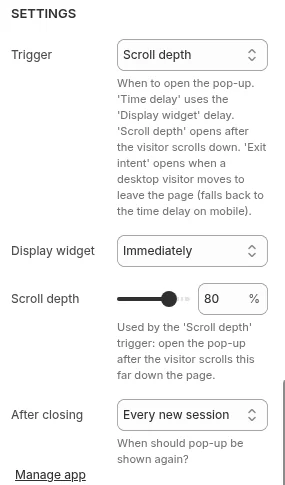
| Reciprocity | Give something first: a welcome discount in exchange for an email | A discount code plus a signup form or popup; our Pop Up Discount app shows a popup by time on page, scroll depth or exit intent that trades a code for an email, and Shopify Flow sends the code |
| Commitment | Make the first step small and keep it saved | Customer accounts, so a returning shopper finds their details and order history |
| Social proof | Show real ratings from real buyers | Product reviews on product pages; in the Shop app only customers who bought the product can review (1 to 5 stars, comment up to 1,000 characters), and ratings are public |
| Liking | Let the shopper see who runs the store | An About page, product copy in your own voice, a photo of the team or the workshop |
| Authority | Show real expertise and make the practical facts easy to find | Credentials and the maker’s story on the About page; refund, shipping and privacy policies under Settings > Policies; contact details on a contact page |
| Scarcity | Use it only when it is true | A limited run you produce once, an end date for a sale you end |
| Unity | Speak to a group the shopper belongs to | Collections and campaigns for a clear audience, such as a hobby, a team or a local community |
Social proof is the principle where the setting matters most, because Shopify’s guide says it must be genuine; for the apps that collect reviews, see product review apps. For authority, the wording of your policies is also what a returning customer reads before they buy again, so write them for the reader in plain sentences.
Three of the rows need a note on how to keep them true:
- Reciprocity works only when the gift is real and the terms are visible. Put the minimum order, the expiry and the products excluded from the code next to the offer, not in a footnote the shopper finds at checkout.
- Commitment is easiest to break at the last step. If a shopper creates an account to save a cart and then meets a fee nobody mentioned, the small first step turns into the hidden-cost pattern described below.
- Scarcity should come from a number you can show: units left from your inventory, a sale that ends on a date you publish and keep. Extending a sale you announced as final makes the published end date untrue, which is the fake-scarcity pattern the guide warns about.
What not to do
- Fake countdown timers and fake scarcity messages. Shopify’s guide lists “fake scarcity messages” among interfaces that create a misleading impression.
- Suppressing negative reviews. The guide says suppressing negative feedback or publishing unverified testimonials violates consumer protection laws, and that the FTC prohibits fake or manipulated reviews.
- Hidden costs. Showing a low price and revealing shipping or fees at checkout is the pattern the guide describes as delaying disclosure of material costs.
- Pre-checked consent. An email box that is already checked collects consent the visitor never gave. Leave it empty.
The guide cites a 2022 FTC report on dark patterns, which groups them into four kinds: inducing a false belief, hiding or delaying material information, unauthorized charges and obscuring privacy choices. Laws differ by country, so ask a local adviser about timers, stock messages and review handling in your markets.
Test one change at a time
Test one principle at a time on your own store. Change one element, such as adding verified reviews above the fold on one product template, and compare the same product before and after, over a period long enough to include a normal week. Avoid running two tests at once, because visitors change with every campaign and you will not know which change moved the number.
Shopify’s reports give you the numbers without an app:
- Open Analytics > Reports and pick Conversion rate breakdown. It shows the share of sessions that added to cart, reached checkout and completed checkout, so you can see which step your change affected.
- Use Conversion rate over time for the before-and-after comparison, with the same number of days on each side.
- Ask Sidekick for a quick cut, for example “Show my conversion rate by device type for the last 30 days”. Shopify says it can answer on session data, conversion rates and landing pages.
One date matters for 2026 comparisons. Shopify rolled out a new session measurement in Shopify Analytics from 21 to September 23, 2026, and its reports page warns that sessions and conversion rate may look different afterwards without any change in your traffic or orders. Do not compare a period before that week with one after it and credit the difference to a new review widget.
Decision fatigue is the related topic of too many options on one page. More guides on running the store are in the running a store hub.
Frequently asked questions
Do countdown timers work? A timer tied to a real end date, such as the last day of a sale, tells the shopper something true; Shopify’s guide suggests a running clock to show when a specific discount or deal expires. A timer that restarts for every visitor is fake scarcity, which the guide warns against, so skip it.
Is showing low stock allowed? Showing low stock is fine when the number comes from your inventory. A “only 3 left” message that is not tied to your inventory is fake scarcity.
What is social proof on Shopify? It is evidence from other buyers shown to a new shopper, mostly product reviews and ratings. Shopify says it needs to be genuine, which means collecting reviews from real buyers and publishing the bad ones too.